
Real estate agents spend a surprising amount of time writing: listing descriptions, follow-up texts, emails to past clients, social posts, and open house invites. AI tools like ChatGPT can take a lot of that first-draft work off your plate, so you can spend more time with clients and less time staring at a blank screen.
Table of Contents
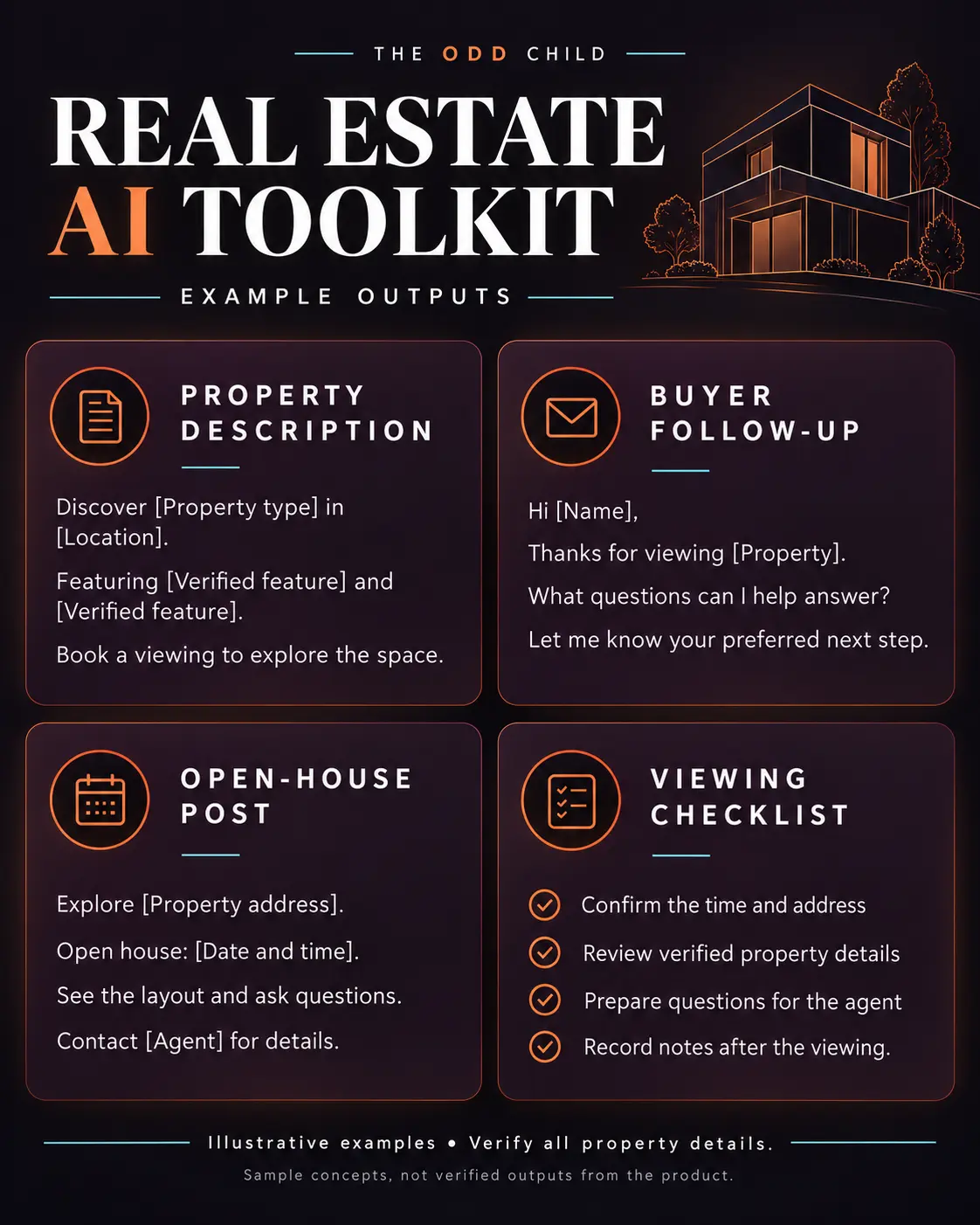
This guide shows you how to use AI prompts for real estate in a practical way. You’ll learn how to give AI the right details, get copy-ready example prompts for listings, follow-ups, and lead generation, and see the mistakes to avoid so your messages stay accurate and sound like you.
Step 1: Give AI the Facts First
AI only knows what you tell it. The better your input, the better the draft. Before writing a listing or message, gather the basics:
- Property type, beds, baths, and square footage
- Standout features (updated kitchen, big yard, natural light)
- Neighborhood highlights you can verify (parks, schools nearby, commute)
- Who the home is likely right for (first-time buyers, growing families, downsizers)
- Your tone (warm, upscale, straightforward)
Paste these into the prompt as a short list. You’ll get much better results than “write a listing for a 3-bedroom house.”
Step 2: Write Listing Descriptions That Sell the Lifestyle
Buyers already see the specs. A good description helps them picture living there. Ask AI to lead with the best feature, describe a few key rooms, and finish with location and a clear next step.
Make one listing work everywhere
- A full MLS-style description
- A short social caption
- A text-friendly two-line version for your contact list
- An email announcement for your newsletter
Always double-check the result against your local MLS rules and fair housing guidelines before posting.
Step 3: Follow Up Without Sounding Robotic
Most deals come from consistent follow-up, and it’s often the first thing that slips when you get busy. AI can help you draft messages for each stage:
- New lead: a quick, friendly response that asks one helpful question.
- After a showing: a thank-you with a short recap and next step.
- Gone quiet: a light check-in that offers something useful.
- Past clients: a home anniversary note or a seasonal check-in.
Keep these as templates, then personalize the first line each time with something real about that person.
Step 4: Use AI for Local Lead Generation Content
People hire agents who clearly know the area. AI can help you plan and draft local content that shows that knowledge:
- Neighborhood guides
- “What I’d look for in a home in [area]” posts
- First-time buyer checklists
- Simple market update scripts (using numbers you pull from your own data)
Let AI outline and draft, then add your own local insight. That personal knowledge is what makes the content worth reading.
Step 5: Plan a Simple Weekly Marketing Routine
Instead of random posting, ask AI to help build a weekly rhythm: one listing or market post, one educational tip, one personal or community post, and one round of follow-ups. A repeatable routine is easier to keep than a big plan.
Example AI Prompts for Real Estate You Can Copy
Replace the bracketed parts with your own details.
Prompt 1: Listing Description
“Write a warm, clear listing description for a [beds]-bed, [baths]-bath [property type] in [area]. Key features: [list]. Ideal buyer: [type]. Lead with the best feature, keep it under 200 words, avoid exaggerated claims, and end with an invitation to book a showing.”
Prompt 2: New Lead Reply
“Write a short, friendly text reply to a new buyer lead who asked about [property or area]. Thank them, answer briefly, and ask one question about their timeline or must-haves. Under 60 words.”
Prompt 3: After-Showing Follow-Up
“Draft a follow-up email after showing [address] to [client name]. Mention [something they liked], ask how they’re feeling about it, and offer two next steps. Keep it warm and under 120 words.”
Prompt 4: Past Client Check-In
“Write a friendly home anniversary message for a past client who bought in [area] [number] years ago. Include one seasonal home tip and a soft line saying I’m always happy to help them or anyone they know.”
Prompt 5: Neighborhood Guide Outline
“Create an outline for a neighborhood guide about [area] for [buyer type]. Include sections for lifestyle, things to do, types of homes, and questions buyers should ask. I’ll fill in local details.”
Mistakes to Avoid
- Posting without fact-checking. AI can invent details. Verify every number, feature, and location claim.
- Ignoring fair housing rules. Describe the property, not who “should” live there based on protected characteristics.
- Sharing private client info. Don’t paste sensitive personal or financial details into AI tools.
- Sounding generic. Add a personal line or local detail to every message.
- Using AI once and forgetting it. Save your best prompts as templates so you get faster over time.
Tip: Keep a short “voice note” at the top of your prompts, like “I sound friendly, direct, and never pushy.” It keeps every draft closer to how you actually talk.
Want a Ready-Made Set of Real Estate Prompts?
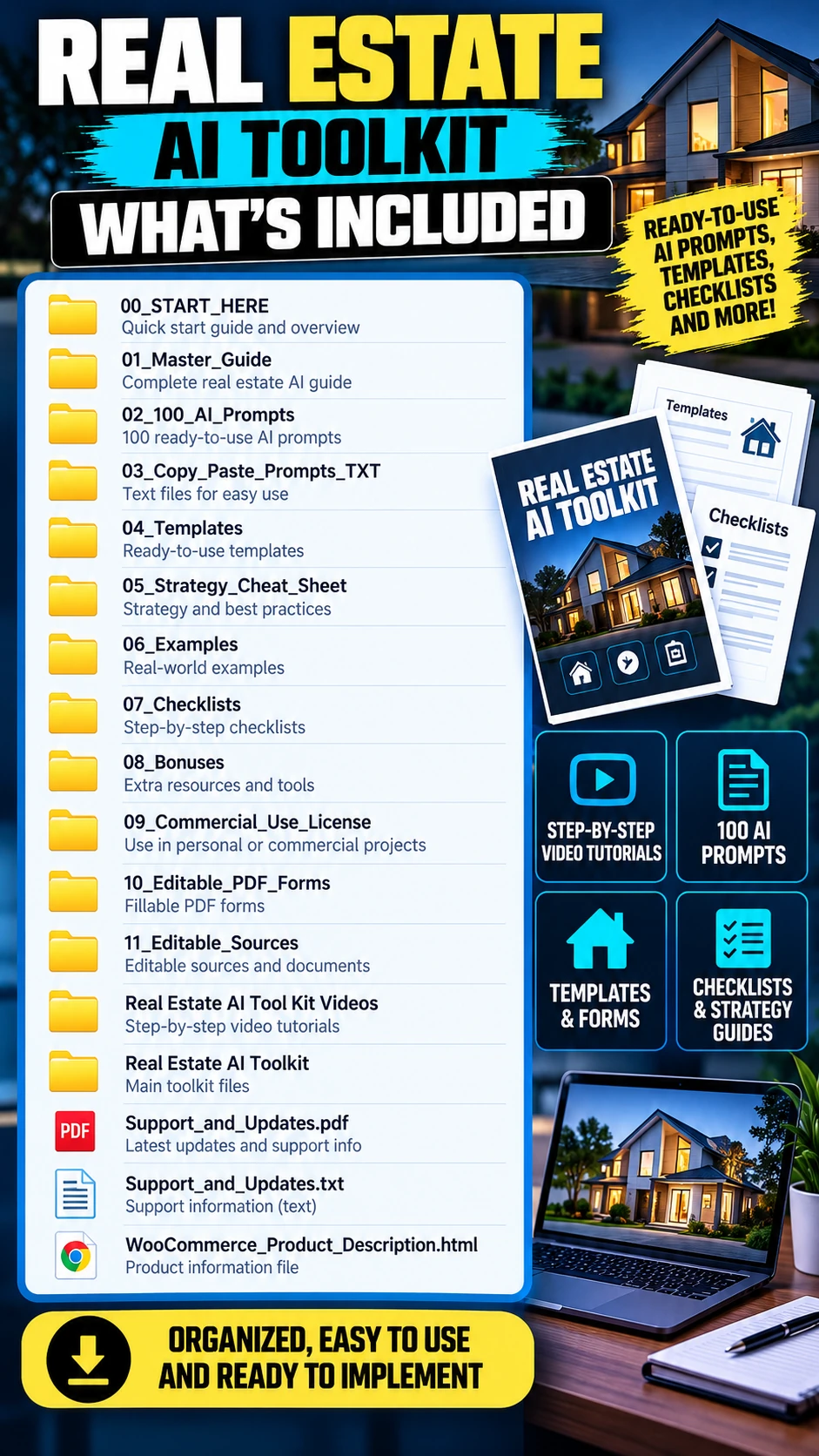
If you want prompts already organized for listings, follow-ups, social posts, and lead nurturing, the Real Estate AI Toolkit gives you a practical starting point you can adapt to your market. For broader business prompts, see our ChatGPT prompts for business guide.
AI Prompts for Real Estate in Practice: One Listing, One Week of Marketing
Here is how this looks in a real week. You take a new listing on Monday: a three-bedroom home near good schools, updated kitchen, big yard, priced in the middle of your market. Instead of writing every piece of marketing from scratch, you run one routine built on AI prompts for real estate and finish most of the week’s writing before your coffee goes cold.
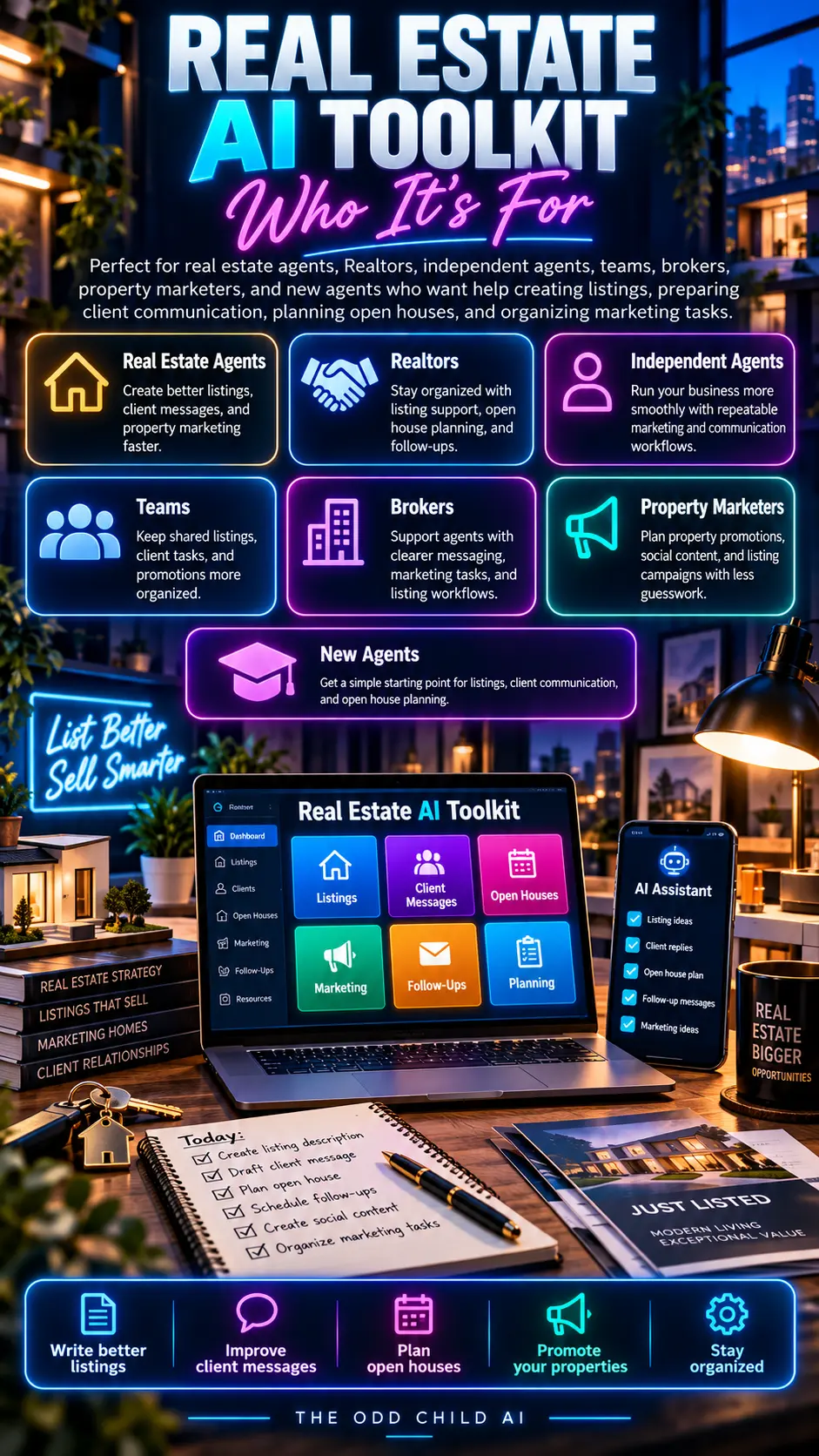
First, you build the fact sheet. You type the property’s real details into your notes: beds, baths, square footage, lot, upgrades, school zone, commute times, and the three things buyers will love most. This fact sheet matters because good prompts always start with true details, never with the AI guessing.
The listing description prompt
“Using only the facts in this fact sheet, write a 180-word listing description for a three-bedroom home. Lead with the lifestyle a buyer gets, not the room list. Mention the updated kitchen, the yard, and the school zone. Warm, clear tone. Do not invent any features.” You read it, fix two phrases, and it is done.
The social and email prompts
Next, you turn that one description into a week of content with three quick prompts. One asks for three social captions with different hooks: the kitchen, the yard, and the “just listed” announcement. One asks for a short email to your buyer list with a clear invitation to the open house. One asks for five text-message-length teasers you can send to buyers who asked about this area.
This repurposing step is where these real estate prompts save the most time. One fact sheet becomes a description, three posts, an email, and a set of texts, and every piece agrees with the others because they all came from the same verified facts.
The follow-up prompts
After the open house, you paste your showing notes into two more prompts. The first drafts a thank-you message to everyone who attended, referencing one detail they mentioned. The second drafts a gentle check-in for the two buyers who seemed serious but have not called back. You personalize each one before sending, because follow-up only works when it sounds like a person who was actually there.
A simple listing marketing checklist
- Build the fact sheet before you write anything.
- Draft the listing description and check every fact twice.
- Repurpose it into three social posts and one buyer email.
- Prepare open house invitations and reminder texts.
- Send personal follow-ups within 24 hours of every showing.
- Save the week’s best-performing post idea for the next listing.
Run that checklist for every listing and your marketing stops depending on how busy the week gets. The prompts carry the routine; you carry the relationships and the judgment.
7 Pro Tips for Agents Using AI
1. Build a fact sheet template. A reusable fact sheet with blanks for beds, baths, upgrades, schools, and lifestyle highlights makes every prompt faster and keeps the AI honest. It is the single most valuable document in your AI workflow.
2. Write for one buyer. Ask the AI to write “for a growing family moving up from a condo” instead of “for buyers.” Specific audiences produce specific, believable copy, and generic audiences produce generic copy.
3. Keep a voice sample. Save two or three of your best past listing descriptions and paste one in with the instruction “match this tone.” Your listings start sounding like you on your best day, every time.
4. Use AI for local content between listings. Slow weeks are when neighborhood guides, market explainers, and “what $X buys you here” posts get written. Prompts make that content fast, and it is the content that brings you leads you did not pay for. The National Association of REALTORS research library is a solid free source of real market data to ground those posts.
5. Follow fair housing rules. Review every AI draft for language that describes people instead of property. Describe the home, the location, and the features — never the “ideal” buyer’s age, family status, or background. When in doubt, check the guidance in HUD’s Fair Housing Act overview.
6. Personalize the last 10 percent. AI drafts the message; you add the one sentence only you can write — the detail from the showing, the street you both mentioned, the timeline they shared. That sentence is what gets replies.
7. Save prompts by stage. Organize your library by listing stage: pre-listing, launch week, open house, follow-up, and past-client nurture. When a new listing lands, you pull the stage folder and run it in order.
5 More Copy-Ready Prompts for Listing Season
Keep these five in the same folder as your stage prompts. They cover the situations that show up every season but never make it into a routine until someone writes them down. Each one assumes you have pasted your facts or notes first — that habit is what makes this routine reliable instead of risky.
Prompt 6: The Price-Adjustment Conversation
“Draft a calm, respectful message to my sellers explaining why I recommend a price adjustment. Use these facts: [days on market, showing feedback, comparable sales]. Acknowledge their position, explain the data plainly, and end with the specific next step I am proposing.”
Prompt 7: The Open House Invitation
“Write an open house invitation for this listing: [fact sheet]. Give me a short email version, a text-message version, and a social post version. Warm and specific, with the date, time, and one standout feature in each. No hype words like ‘stunning’ or ‘won’t last long.'”
Prompt 8: The Buyer Consultation Follow-Up
“Turn these notes from a buyer consultation into a follow-up email: [notes]. Summarize what we discussed, restate their must-haves back to them, explain my next two steps, and end with one easy question they can answer by reply.”
Prompt 9: The Neighborhood Spotlight
“Help me outline a neighborhood spotlight post about [area]. Include sections on: what daily life feels like there, the homes and price ranges, schools and parks, and who tends to love living there. Ask me questions where you need facts you do not have.”
Prompt 10: The Annual Home Anniversary Note
“Write a short note to past clients who bought a home with me around this time last year. Congratulate them on the anniversary, share one useful homeowner tip for this season, and remind them I am happy to help anyone they know who is thinking of moving. No sales pitch.”
Save the versions that sound most like you. Over a season, these five prompts quietly handle the messages agents usually postpone — and postponed messages are where deals and referrals go to die.
Frequently Asked Questions About AI Prompts for Real Estate
Are AI prompts for real estate legal and compliant to use?
Yes, with your review. AI is a drafting tool, and you are responsible for everything you publish, exactly as if you wrote it yourself. Check facts against the MLS and your listing documents, follow your brokerage’s policies, and review language for fair housing compliance before anything goes out.
Will buyers and sellers know I used AI?
They will know if the copy sounds generic. They will not care if it sounds like you, gets the facts right, and answers their questions. Clients judge the result, not the tool. Edit every draft into your voice and add real local detail, and these prompts become invisible — in a good way.
What is the best first prompt for a new agent to try?
Start with the listing description prompt using a complete fact sheet. It is the highest-value, lowest-risk place to begin: the facts are fixed, the format is familiar, and you will see immediately how much drafting time you save. Then add the follow-up prompts, which is where most agents feel the biggest weekly relief.
Can AI help with lead generation, not just listings?
Yes. Use it to draft neighborhood guides, first-time buyer checklists, seller preparation guides, and answers to the questions buyers ask you every week. That helpful local content is what ranks in search and gets shared, and each piece can end with an invitation to talk. These real estate prompts work just as well for attracting clients as for marketing homes.
How do I stop AI copy from sounding like every other agent?
Give it your voice sample, your local knowledge, and your opinion. AI sounds generic when it is given generic input. Feed it the name of the coffee shop on the corner, the trail your buyers love, and your honest take on the street, and the draft comes back sounding like the local expert you are.
Quick Recap
AI prompts for real estate work best when you feed them real facts and treat the output as a first draft. Use them to write listings, follow up at every stage, create local content, and keep a steady weekly marketing routine. Fact-check, stay compliant, and add your personal touch, and AI becomes a real time-saver.

Your Next Step: Run the One-Listing Routine
Pick your next listing and run the full routine once: fact sheet, description, three posts, one email, and personal follow-ups. Time it. Most agents are surprised how much of the week’s writing disappears, and the routine gets faster every time you repeat it.
Want the prompts already written and organized by stage? The Real Estate AI Toolkit includes listing, follow-up, and lead generation prompts ready to adapt. New to AI tools? Start with our 30 free AI prompts first.
Keep reading: AI Prompts for Small Business Marketing That Save Hours Each Week and AI Prompts for Contractors: Quotes, Follow-Ups, and Local Marketing.